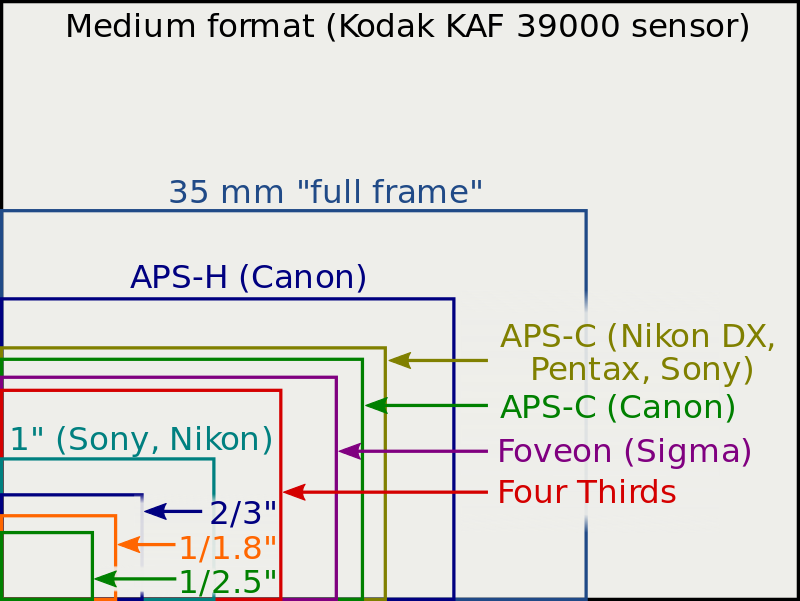
Quick answer: A full-frame sensor measures 36 × 24 mm, the size of a 35mm film frame. A crop sensor (usually APS-C or Micro Four Thirds) is smaller, so it “crops” the image and makes lenses act longer. Full frame wins for low light, shallow depth of field and wide angles; crop sensors win on price, size, weight and telephoto reach. Most beginners are well served by a crop-sensor camera.
Sensor Sizes and Crop Factor
| Format | Approx. size | Crop factor | A 50mm lens looks like |
|---|---|---|---|
| Full frame | 36 × 24 mm | 1.0× | 50mm |
| APS-C (Nikon, Sony, Fujifilm) | 23.5 × 15.6 mm | 1.5× | 75mm |
| APS-C (Canon) | 22.3 × 14.9 mm | 1.6× | 80mm |
| Micro Four Thirds | 17.3 × 13 mm | 2.0× | 100mm |
The crop factor does not change the lens; it changes how much of the image circle the sensor records, which narrows the field of view.
Full Frame vs Crop: Head to Head
| Factor | Full frame | Crop sensor |
|---|---|---|
| Low-light noise | Better, roughly one stop cleaner | Good, improving every generation |
| Background blur | Easier to get shallow depth of field | Needs faster lenses for the same look |
| Telephoto reach | Needs longer, pricier lenses | 1.5–2× “free” reach |
| Wide-angle | Easy and cheaper | Needs very short focal lengths |
| Size and weight | Larger bodies and lenses | Smaller, lighter kit |
| Price | Higher for body and lenses | Lower overall |
Which Should You Choose?
- Beginners and families: crop sensor. You learn just as much and spend less.
- Wildlife and sports: crop sensor for reach, or full frame with long lenses if budget allows.
- Portraits and weddings: full frame for low light and creamy backgrounds.
- Landscapes and astro: full frame for wide angles and night noise.
- Travel: crop sensor for a lighter bag.
Lens Compatibility
Full-frame lenses work on crop bodies of the same mount. Crop-only lenses (Canon RF-S, Nikon DX, Sony E APS-C) work on full-frame bodies only in a cropped mode that lowers resolution. If you plan to upgrade later, buying full-frame lenses now can save money. For Nikon specifics, see which Nikon lenses fit which cameras.
Common Myths
- “Crop sensors zoom in.” They only crop the frame; there is no optical magnification.
- “Pros only use full frame.” Many wildlife and sports pros use crop bodies for reach and speed.
- “APS-C and CMOS are opposites.” APS-C is a size; CMOS is a sensor technology. Our APS-C vs CMOS guide explains the difference.
Weighing a new body? Canon owners can compare options in our Canon 90D successor guide.
Frequently Asked Questions
Is full frame worth it for beginners?
Usually not. Spend the difference on a good lens and learning.
Does a crop sensor give lower image quality?
Slightly more noise at high ISO, but modern APS-C cameras produce excellent images in normal light.
Is a phone sensor a crop sensor?
Yes, a much smaller one, which is why phones rely heavily on computational processing.